 ← BACK TO CATALOG
TINY DESK COMPANION
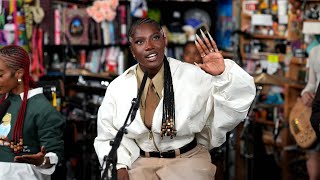
Sampa The Great
summary
Watch on NPREvery sound has a story. Scroll to trace the musical DNA behind this performance — 11 connections, each one cited from real music journalism and criticism.
Lauryn Hill
influenced by
Lauryn Hill
Lauryn Hill is Sampa Tembo's self-described 'ultimate inspiration' — the artist who introduced her to hip-hop and gave her the confidence to be a woman in the genre. 'Lauryn was everything to me. She taught me that you didn't have to fit into a blueprint as a woman. You could be yourself.' Sampa began writing songs after discovering Hill in her teens, and later supported her on tour — a full-circle moment for an artist who grew up treating The Miseducation of Lauryn Hill as a foundational text. Sampa's early mixtapes carry Hill's DNA: the free-flowing lyricism between rap and sung melody, the unapologetic spiritual introspection, and the willingness to centre Black womanhood as a site of radical power.
“She is my ultimate inspiration. She introduced me to hip-hop; she gave me the confidence to be a woman in hip-hop.”
The Gentlewoman ↗
Sonic DNA
Key Works
W.I.T.C.H.
influenced by
W.I.T.C.H.
WITCH (We Intend To Cause Havoc) are Zamrock royalty — and for Sampa, a deeply personal inheritance. After relocating to Zambia during the pandemic, her father revealed that her uncle, George 'Groovy Joe' Kunda, was a founding member of the band. The revelation transformed her relationship to her own musical lineage. 'I still wish I had that in the beginning of my career!' she said, noting it would have eased her fear of failure. She solidified the connection by inviting original WITCH singer Jagari Chanda to perform on 'Can I Live' from As Above, So Below, and archival WITCH footage anchors the 'Never Forget' video. The collaboration was not merely nostalgic — it was a reclamation of a musical tradition that had been globally celebrated yet underacknowledged in Zambia itself.
“That little spill of encouragement was all I needed. It gave me more of a bond and connection with Witch.”
Vulture ↗
Sonic DNA
Key Works
Zamrock
influenced by
Zamrock
Zamrock — Zambia's extraordinary 1970s synthesis of psychedelic rock, reggae, funk, and traditional Bantu rhythms — is the cultural backbone of Sampa's second album. She discovered it as an adult, outside of Zambia, and was struck by how globally known yet domestically undervalued it was. 'I discovered Zamrock later in my life and was surprised that this music was known globally, yet not fully celebrated and acknowledged in Zambia today.' The genre's origins in President Kenneth Kaunda's 1964 decree that 95% of radio music must be Zambian-made gave it a radical, postcolonial character that resonates with Sampa's own resistance to being rebranded as 'Australia's rapper.' Her 'hybrid music' philosophy — blending hip-hop, soul, and African tradition — is Zamrock's spirit reborn in a new era.
Sonic DNA
Key Works
Little Simz
similar
Little Simz
Last.fm ranks Little Simz as the second closest artist to Sampa (similarity: 0.879). The comparison is critical shorthand for a generation of critics: both are Black women from the African diaspora making uncompromising, politically conscious hip-hop that refuses American industry blueprints. Simz from North London, Sampa from Zambia via Botswana and Australia — both speak their own cultural truth with technical precision and emotional depth. Critics frequently co-mention them as co-leaders of a new global wave of Black feminist rap that is rewriting what the genre can look and sound like.
Sonic DNA
Kojey Radical
collaborated with
Kojey Radical
Kojey Radical features on 'IDGAF' from As Above, So Below, delivering what Exclaim! called 'a devastating verse.' Last.fm places him as the single closest artist to Sampa in listener behavior (similarity: 1.0), suggesting their audiences are deeply overlapping. Both inhabit a post-genre space where UK/diaspora rap meets neo-soul, gospel, and political oratory — artists who treat the microphone as both weapon and healing instrument. Kojey's Afro-British perspective complements Sampa's Zambian-Australian one, and their chemistry on 'IDGAF' points to a shared artistic DNA.
Sonic DNA
Kendrick Lamar
influenced by
Kendrick Lamar
Sampa has cited Kendrick Lamar's good kid, m.A.A.d city as a record that 'taught me that it was okay to always give an honest piece of myself in my art' — a principle visible across her confessional, diaspora-mapping albums. She also toured with Lamar, an experience that shaped her understanding of music as large-scale cultural storytelling. His influence is felt most clearly in Sampa's approach to album architecture: both The Return and As Above, So Below are conceived as complete, immersive narrative journeys rather than collections of singles, with interludes, spoken word, and concept threading everything together.
Sonic DNA
Key Works
Paul Ngozi
influenced by
Paul Ngozi
Zamrock guitar pioneer Paul Ngozi is an ancestral touchstone for Sampa's Africa-rooted sound. Best known for the kalindula-style electric guitar work that became a signature of Zambian rock, Ngozi's archival footage appears alongside WITCH in Sampa's 'Never Forget' video — a deliberate act of canon-building. He represents the generation of Zambian artists who fused Western psychedelic rock with indigenous rhythms under Kaunda's cultural decree, creating the very hybrid music tradition Sampa is extending into the 21st century.
Sonic DNA
Angélique Kidjo
collaborated with
Angélique Kidjo
Grammy-winning Beninese icon Angélique Kidjo collaborated with Sampa on 'Let Me Be Great' from As Above, So Below — a pairing of two pan-African women who have each refused to be categorised by Western genre conventions. For Sampa, aligning with Kidjo was an act of artistic genealogy: placing herself in a lineage of African women who have claimed global stages on their own cultural terms. The track is a celebration of self-determination, and Kidjo's presence signals Sampa's ambition to speak not just to a diaspora but to the entire African continent.
Sonic DNA
Key Works
Joey Bada$$
collaborated with
Joey Bada$$
Joey Bada$$ collaborated with Sampa on 'Mask On' from As Above, So Below, and she also toured with him early in her career. The track fuses Zambian nursery rhymes with rugged New York boom-bap energy, with both rappers examining the masks imposed on them by racial and social systems. Pitchfork noted the track 'slinks into a swaying blend of hi-hats and blues guitar reminiscent of UGK's country rap' — the transatlantic cultural collision that defines Sampa's work at its most adventurous.
Sonic DNA
Noname
similar
Noname
Last.fm similarity score of 0.575. Noname and Sampa occupy a shared artistic territory: jazz-inflected hip-hop built from spoken-word precision, radical Black political consciousness, and a deep resistance to commercial compromise. Both artists treat the album as an act of community rather than product, and both have become talismans for listeners who want hip-hop that is simultaneously intellectual and emotionally alive. The Pitchfork review of The Return noted Sampa's 'beats that pull in bits of jazz alongside '90s R&B and hip-hop' — the same critical vocabulary used for Noname's Room 25.
Sonic DNA
Rapsody
similar
Rapsody
Last.fm similarity score of 0.634. Rapsody and Sampa are frequently bracketed as two of the most lyrically rigorous women in contemporary hip-hop — both rooted in Black consciousness traditions, both technically formidable, and both committed to albums of substance over singles culture. Rapsody's Eve (2019), a concept album celebrating Black womanhood through the lens of iconic women in history, mirrors the thematic ambition of Sampa's The Return, where diaspora and identity are the central subjects.
Sonic DNA